Antique Glass Prosthetic Eyes
Hand-blown German craftsmanship and the startling realism of vintage ocular prosthetics.
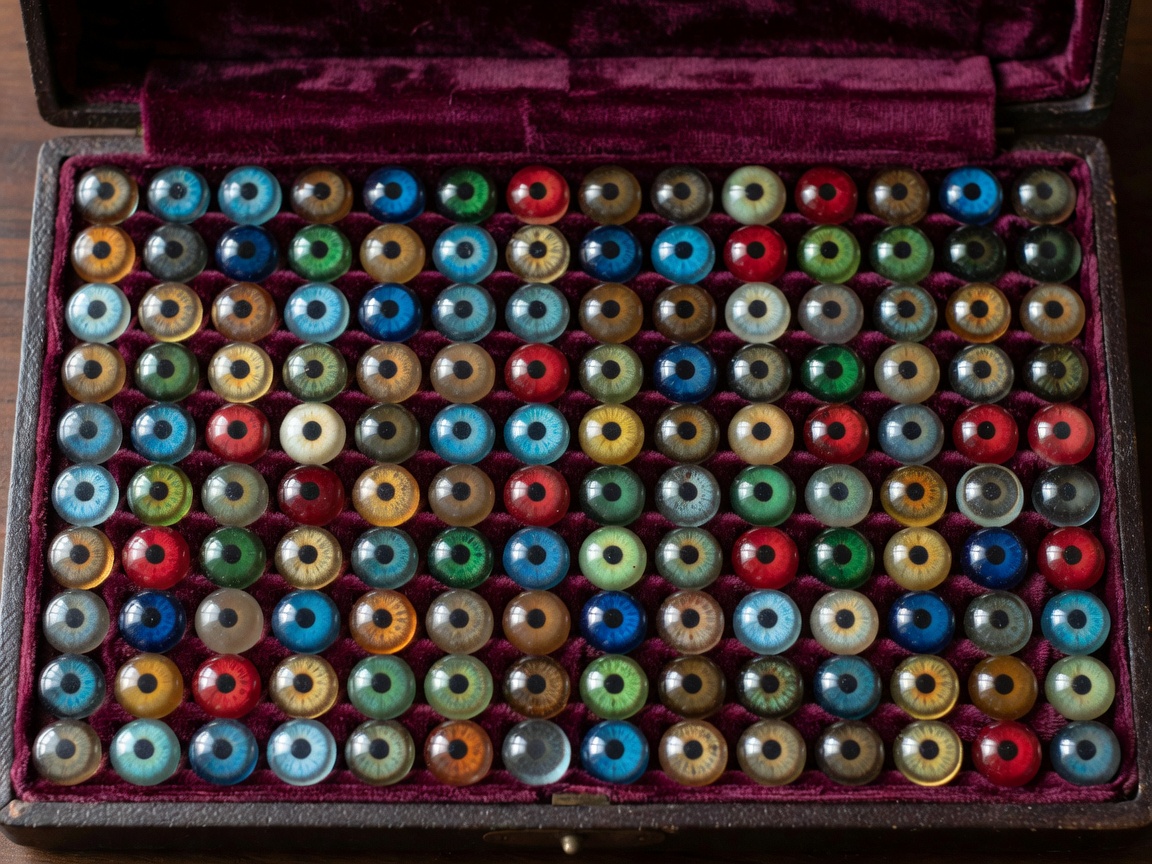
There is an undeniable, uncanny power in an object that looks back at you. For collectors of antique ocular prosthetics, this gaze represents the intersection of medical necessity and breathtaking artistic craftsmanship. Before the advent of acrylics in the mid-20th century, the creation of artificial eyes was a highly secretive, specialized trade dominated by master glassblowers whose skills bordered on the miraculous.
The German Glassblowing Tradition
The golden age of the glass eye began in the mid-19th century in Lauscha, a small town in the Thuringian forest of Germany. Lauscha was already famous for its glasswork (particularly for inventing the modern glass Christmas ornament), but in 1835, a local glassblower named Ludwig Müller-Uri developed a proprietary cryolite glass. This specific type of glass had a slightly milky opacity that perfectly mimicked the natural white sclera of a human eye.
The process was painstakingly manual. An ocularist would use a Bunsen burner to shape a hollow sphere of cryolite glass. They would then use tiny rods of colored glass to meticulously paint the iris and pupil directly into the molten surface. Finally, tiny threads of red glass were fused onto the sclera to replicate delicate blood vessels. The result was a prosthesis of startling realism and depth that modern acrylics struggle to match.
Types and Variations in Collections
While the goal of the ocularist was uniformity with the patient's remaining eye, the needs of the medical community resulted in various fascinating types of eyes that collectors seek out today:
- Snellen Reform Eyes: Introduced in the late 19th century, these eyes featured a hollow, double-walled design with a rounded back. This allowed the prosthesis to sit more comfortably in the socket and move more naturally with the underlying muscles.
- Shell Eyes: Thinner, single-walled glass shells designed to be worn over a blind but intact eyeball. These are highly delicate and prone to breaking, making surviving examples rare.
- Pathological Models: Some glass eyes were created not for wear, but for medical education. These feature detailed depictions of ocular diseases, such as cataracts, jaundice, or severe trauma. Because of their rarity and striking appearance, pathological models are highly prized.
- Salesman Sample Cases: The holy grail for many collectors is an intact salesman’s sample case—a velvet-lined briefcase containing dozens or even hundreds of eyes in a gradient of colors and sizes, used to match a patient's natural eye.
Condition and Preservation
Glass is inherently fragile, and survival rates for everyday wear items are low. Prosthetic glass eyes were also subject to degradation from the wearer's tear fluids, which could etch and dull the glass over a few years, requiring regular replacement.
When assessing a piece, collectors look for the clarity of the glass, the intricacy of the iris coloration, and the absence of chips or cracks around the delicate rear edges. Because they are hollow, they must be protected from sudden, extreme temperature changes which can cause the sealed air inside to expand and shatter the glass.
The Market for the Uncanny
The market for antique glass eyes is robust, fueled by collectors of oddities, medical historians, and admirers of glass art. Single, common glass eyes can often be acquired relatively easily, making this an accessible hobby for beginners. However, rare colors (like deep violet or heterochromic designs), pathological models, and complete, documented practitioner kits can draw substantial interest at specialized auctions.
Ultimately, a collection of antique glass eyes is a gallery of individualized portraits. Each piece was custom-made to restore normalcy and dignity to a specific, unknown person in the past, capturing a unique human gaze in imperishable glass.